.png)
Why the Costa del Sol Is the Perfect Winter Holiday Destination
Discover why the Costa del Sol is more than a summer destination. Explore winter holidays, golf, outdoor activities, culture and events from Málaga to Sotogrande.


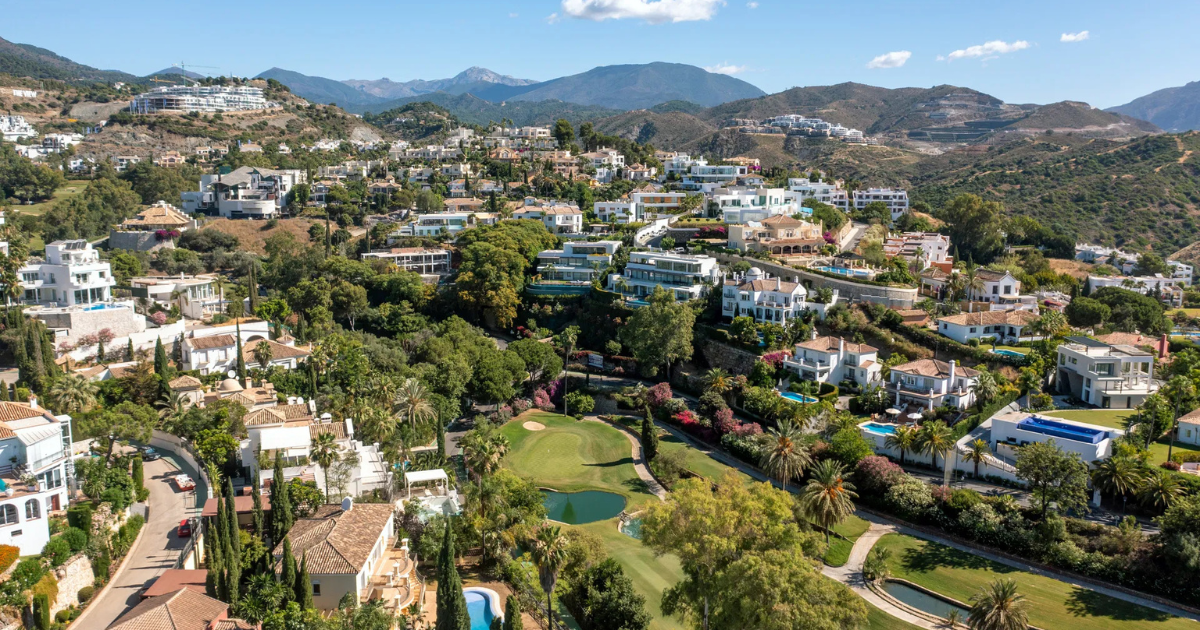
For decades, the Costa del Sol has been associated with sunshine, golf, beaches and second homes. Today, however, the region has evolved into something considerably more significant: one of Europe’s leading luxury residential property markets.
At the heart of this transformation are Marbella, Benahavís and Estepona. Together, these destinations are attracting wealthy international buyers looking for more than a holiday home. They are increasingly seeking permanent or semi-permanent residences, investment properties and highly personalised homes in locations offering an exceptional combination of lifestyle, security, connectivity and international services.
The latest property figures underline just how strong the market has become. In July 2026, Marbella’s average asking price reached €5,950 per m²,while Estepona reached €4,902 per m². Benahavís recorded €5,496 per m² when the municipality’s broader market is considered, with some of its most prestigious communities considerably higher.
This places the leading areas of the western Costa del Sol firmly alongside — and in some locations above — Spain’s traditional premium residential markets.
The scale of the price difference becomes clearer when the Costa del Sol is compared with Spain as a whole.
According to Idealista’s July 2026 data, the average asking price across Spain was €2,933per m². Andalucía averaged €2,925 per m². By comparison:
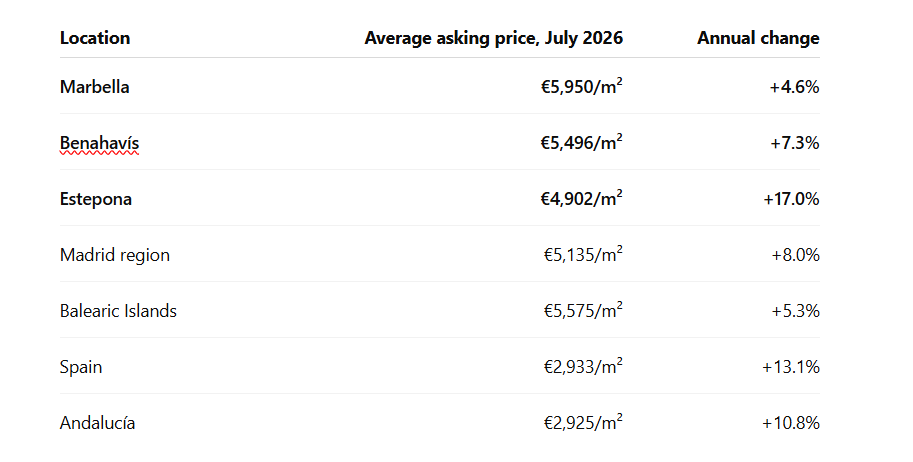
The figures demonstrate that Marbella and Benahavís are operating at a completely different price level from the Spanish market as a whole, while Estepona is experiencing particularly strong price growth. Marbella’s average asking price is now more than double the Spanish average, while Benahavís is around 87% higher. Estepona is approximately 67% above the national average. And these municipality-wide averages only tell part of the story. In the most exclusive neighbourhoods, prices are considerably higher.
Marbella remains the undisputed flagship of the Costa del Sol luxury market. The town’s reputation was established decades ago, but the nature of its appeal has changed significantly. The modern Marbella market is increasingly driven by international wealth looking for high-quality permanent residences rather than simply seasonal holiday properties.
The July 2026 average of €5,950 per m² places Marbella among Spain’s most expensive mainstream residential markets.
But prime locations are substantially more expensive. In Nagüeles-Milla de Oro, average asking prices reached €8,269per m² in July 2026, while Nueva Andalucía reached €6,249 per m². Elviria-Cabopino stood at €4,620 per m² and Rio Real-Los Monteros at €5,543 perm².
This concentration of high-value property is one of Marbella’s greatest strengths.
Areas such as:
have created an ecosystem where ultra-prime villas, branded residences, designer apartments and new-build developments can command substantial premiums.
The luxury market is also becoming increasingly international. According to recent industry reporting, Marbella is now regarded among the world’s leading destinations for high-net-worth residential buyers, competing with established luxury locations such as Monaco, Miami and Saint-Tropez.
If Marbella represents the Costa del Sol’s global luxury brand, Benahavís represents exclusivity, privacy and space.
Located immediately inland from Marbella, Benahavís offers something increasingly difficult to find in Europe’s established luxury markets: large private homes, substantial plots, dramatic mountain views and gated communities while remaining close to Marbella, Puerto Banús and the coast.
The municipality recorded an average asking price of €5,496 perm² in July 2026, up 7.3% year-on-year. But the headline figure disguises considerable variation between developments.
Prime communities include:
Within these areas, asking prices can be substantially above the municipal average.
For example, idealista recorded approximately €7,973 per m² in La Zagaleta, €7,959 per m² in El Madroñal and €6,145 per m² in La Quinta during July 2026. This illustrates an important feature of the Costa del Sol luxury market: location within a municipality can be just as important as the municipality itself.
A villa in an ultra-exclusive gated community can sit in an entirely different price category from a conventional apartment only a few kilometres away.
Perhaps the most interesting story is currently being told further west.
Estepona has undergone a remarkable transformation over the last decade, developing from a traditional Costa del Sol town into a sophisticated international residential destination.
The latest figures suggest that the market is accelerating. In July 2026, Estepona’s average asking price reached €4,902 per m² — an extraordinary 17% higher than a year earlier. That annual growth rate is considerably stronger than Marbella’s 4.6% and Benahavís’ 7.3%. The transformation of Estepona has been driven by several factors.
The town has seen substantial investment in high-end apartments, penthouses and villas, particularly along the seafront and western and eastern approaches.
Modern developments increasingly offer:
This has broadened the luxury market beyond traditional villas.
Estepona’s historic centre, renovated streets, beaches, marina, restaurants and expanding range of services have helped create a location that works throughout the year.
That is particularly attractive to international buyers who want to spend several months of the year in Spain rather than simply visit for a two-week holiday.
The Balearic Islands remain among Spain’s most expensive residential markets.
The average property price across the Balearics reached €5,575per m² in July 2026, only slightly below Marbella’s €5,950 per m².
However, the comparison becomes particularly interesting when looking at Ibiza.
Ibiza reached €7,606 per m², while Formentera reached an extraordinary €9,708 per m².
These figures demonstrate that the Costa del Sol is not universally Spain’s most expensive luxury market. Certain island markets command substantially higher prices.
But the Costa del Sol has a major advantage: scale. It offers a much larger and more diverse luxury residential market, stretching from Málaga through Marbella, Benahavís and Estepona towards Sotogrande.
Buyers can therefore choose between beachfront apartments, golf developments, gated communities, mountain villas, marina properties and large private estates. That breadth is one of the reasons the market continues to attract international capital.
Madrid is Spain’s other major premium residential market. The Madrid region averaged €5,135 per m² in July 2026, compared with €5,950 in Marbella. However, the two markets appeal to very different buyers.
Madrid offers:
Marbella offers a different proposition:
For wealthy individuals able to work remotely or who have already accumulated their wealth, the lifestyle proposition can therefore be extremely compelling.
The Costa del Sol increasingly allows buyers to combine the benefits of a luxury holiday destination with the infrastructure of a genuine international residential community.
Luxury property has changed. Today’s high-net-worth buyer is not necessarily looking simply for the biggest house or the most expensive postcode.
Increasingly, they are buying a lifestyle ecosystem.
That means access to:
Marbella has invested heavily in developing this ecosystem, while Benahavís offers privacy and natural surroundings and Estepona has increasingly positioned itself as a high-quality year-round residential destination.
This is helping the western Costa del Sol compete with established luxury markets across Europe.
The Costa del Sol’s luxury property market is particularly resilient because it is not dependent on one domestic buyer group.
Demand comes from a broad range of international markets, including buyers from the UK, Scandinavia, the Netherlands, Belgium, Germany, France, the Middle East and increasingly North America.
The international nature of demand helps create a more diversified market. It also means that luxury properties can continue to attract buyers even when conditions in individual European economies change. For many purchasers, the property is not simply an investment. It can be:
A second home + retirement residence + lifestyle investment + short-mid-long term property rental investment.
That combination is particularly powerful.
One of the most important changes in the region is the move away from a purely seasonal tourism model. The Costa del Sol increasingly operates throughout the year.
Golf, wellness, gastronomy, international education, business travel, remote working and longer stays are reducing the reliance on traditional summer tourism. This is important for property values.
A destination capable of attracting affluent residents for six, nine or twelve months of the year has a fundamentally different residential proposition from a location that relies heavily on a short summer season.
The expansion of Málaga as an international city and business destination is also helping the wider Costa del Sol. The result is a connected luxury corridor extending from Málaga towards Marbella, Benahavís and Estepona and continuing west towards Sotogrande.
Another major factor behind the Costa del Sol’s luxury property performance is supply.
There is only a limited amount of prime coastal land, while highly desirable locations such as beachfront Marbella, the Golden Mile and established gated communities cannot simply be replicated. This scarcity becomes particularly important at the top end of the market.
A buyer looking for:
has a relatively limited number of properties from which to choose. As demand increases, scarcity can create substantial price premiums.
Marbella is already established.
Benahavís is already synonymous with exclusivity.
Estepona, however, may offer the greatest transformation story.
With prices reaching €4,902 per m² and annual growth of 17% in July 2026, the market is showing considerable momentum. The town still offers comparatively more value than the most expensive parts of Marbella, while providing many of the lifestyle characteristics international buyers are seeking.
This creates an attractive proposition for buyers who want a luxury property but are prepared to move slightly west of Marbella. The development of new residential projects, improved infrastructure and growing international recognition could further strengthen Estepona’s position over the coming years.
The Costa del Sol should not be viewed as a single property market. It is better understood as a series of interconnected luxury markets.
Marbella offers international recognition, established prestige and some of Spain’s most expensive residential neighbourhoods.
Benahavís provides privacy, space, gated communities and ultra-prime villas.
Estepona combines strong growth, new luxury development and comparatively greater value.
And beyond these three, locations such as Mijas, Fuengirola, Manilva and Sotogrande are creating additional opportunities at different price points.
This diversity is one of the Costa del Sol’s greatest strengths.
The latest figures suggest that the Costa del Sol is no longer simply participating in Spain’s luxury property market — it is helping to define it.
Marbella’s average asking price of €5,950 per m² is above the Madrid regional average of €5,135 per m², while Benahavís is at €5,496 per m² and Estepona has recorded one of the strongest rates of annual growth at 17%.
The Balearics remain formidable competitors, particularly Ibiza and Formentera, where prices are significantly higher. But the Costa del Sol offers something those markets cannot easily replicate: a vast, interconnected luxury residential ecosystem with multiple towns, property types and price points.
For international property buyers, that combination is increasingly difficult to ignore.
The Costa del Sol offers the opportunity to own a luxury home in one of Europe’s most desirable lifestyle destinations while benefiting from an established international community, year-round amenities and a property market that continues to attract substantial global demand.
Marbella may have built the Costa del Sol’s luxury reputation, Benahavís has taken exclusivity to another level, and Estepona is rapidly becoming the region’s next major luxury growth story.
Together, they are helping to establish the Costa del Sol as one of Spain’s — and increasingly Europe’s — most important luxury residential markets.
Property prices quoted in this article are asking-price data from idealista for July 2026 and should not be interpreted as achieved transaction prices. Luxury and prime property can command prices substantially above municipal averages. Market conditions can change, and prospective buyers should obtain independent valuation and legal advice before making an investment decision.
Latest market trends, investments, and property developments in the Iberian Peninsula
Feel free to call us from
Mon - Fri (9:00 - 18:00 CET).
Our team will be happy to help answer your questions that you may have.




.png)

.png)

