Spain's New 10% VAT on Holiday Rentals: Andalucía Property Owner Guide 2026–2027
Spain’s New 10% VAT on Holiday Rentals: What Property Owners in Andalucía Need to Know.
From 1 December 2026, Spain’s short-term rental market will undergo a significant change, with the introduction of 10% VAT on qualifying furnished holiday accommodation. However, the new legislation also presents an opportunity for property owners to recover VAT on many of the expenses associated with operating their rental properties.
Spain's holiday rental sector is entering a new phase of fiscal regulation following the ratification of Royal Decree-Law 29/2026 on 12November 2026. From 1 December, many privately owned holiday apartments and villas that previously benefited from a VAT exemption will become subject to a reduced VAT rate of 10%, known in Spain as IVA (Impuesto sobre el Valor Añadido).
For property owners across Andalucía, particularly along the Costa del Sol, Costa de la Luz and Costa Tropical, the changes will have implications for rental pricing, property management, accounting and overall profitability. Whilst the introduction of VAT represents an additional tax obligation, the ability to reclaim VAT on qualifying operational expenses could help offset a significant proportion of the financial impact. Source: Agencia Tributaria
Understanding the new 10% VAT legislation
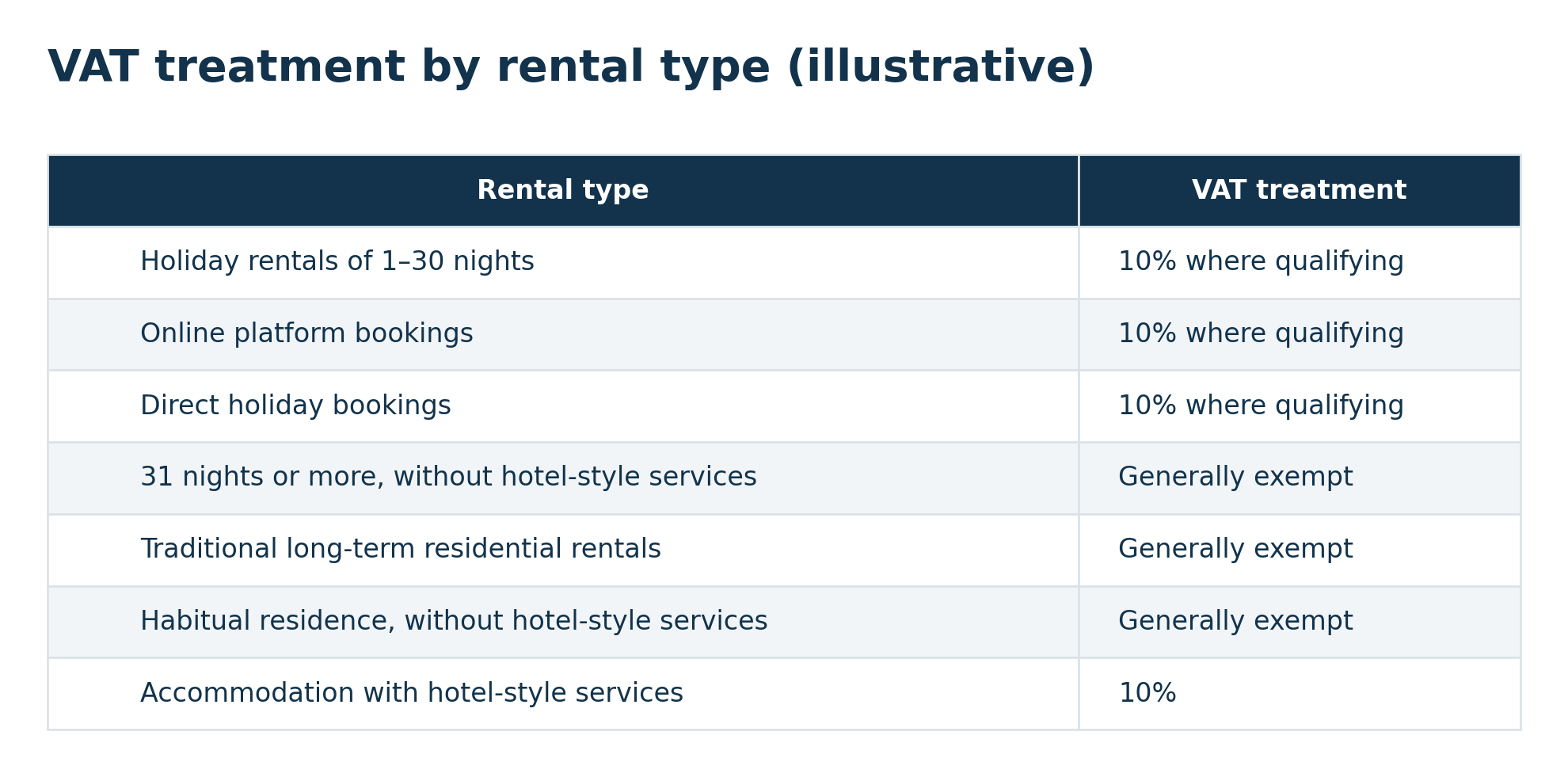
Under the previous legislation, most privately owned holiday rental properties were exempt from VAT, provided the owner did not offer services typically associated with the hotel industry. From 1 December 2026, furnished properties rented to the same guest for 30 nights or fewer will generally be subject to 10% VAT, regardless of whether hotel-style services are provided. The legislation applies to both Spanish residents and overseas property owners and is not restricted to properties advertised through major online booking platforms.
Type of property rental - VAT treatment from 1 December 2026
The 30-night threshold is particularly important for owners offering longer winter stays, digital nomad accommodation and seasonal rentals. Source: Agencia Tributaria
What does the new VAT mean for Andalucía?
As one of Spain's most established international tourism destinations, Andalucía has a substantial market for privately owned holiday villas, apartments and second homes. Property owners in popular destinations such as Marbella, Estepona, Mijas, Benalmádena, Fuengirola, Málaga, Nerja, Cádiz and Seville will need to adapt their rental operations to the new requirements. The legislation is national rather than specific to Andalucía and applies regardless of the size of the municipality or the number of properties an individual owns.
For Andalucía's holiday rental market, the main implications are likely to include:
Adjustments to nightly and weekly rental prices.
Increased accounting and tax reporting requirements.
Greater emphasis on professional property management.
Opportunities to recover VAT on operational expenditure.
Potential changes to the balance between short-term and extended seasonal rentals.
Increased importance of obtaining correctly issued invoices from service providers
The rate of 10% also brings qualifying private holiday accommodation into closer fiscal alignment with Spain's established hotel sector. Importantly, the new VAT obligations are separate from Andalucía's existing tourist rental licensing, registration and municipal planning requirements.
The positive side: reclaiming VAT on property managementand rental expenses
One of the most important benefits of the new legislation is the potential for property owners to recover VAT paid on goods and services associated with their taxable rental activity. Previously, owners operating VAT-exempt holiday rentals were generally unable to recover the VAT charged by property management companies, cleaning contractors, maintenance providers and other suppliers. This effectively made VAT an additional operating expense.
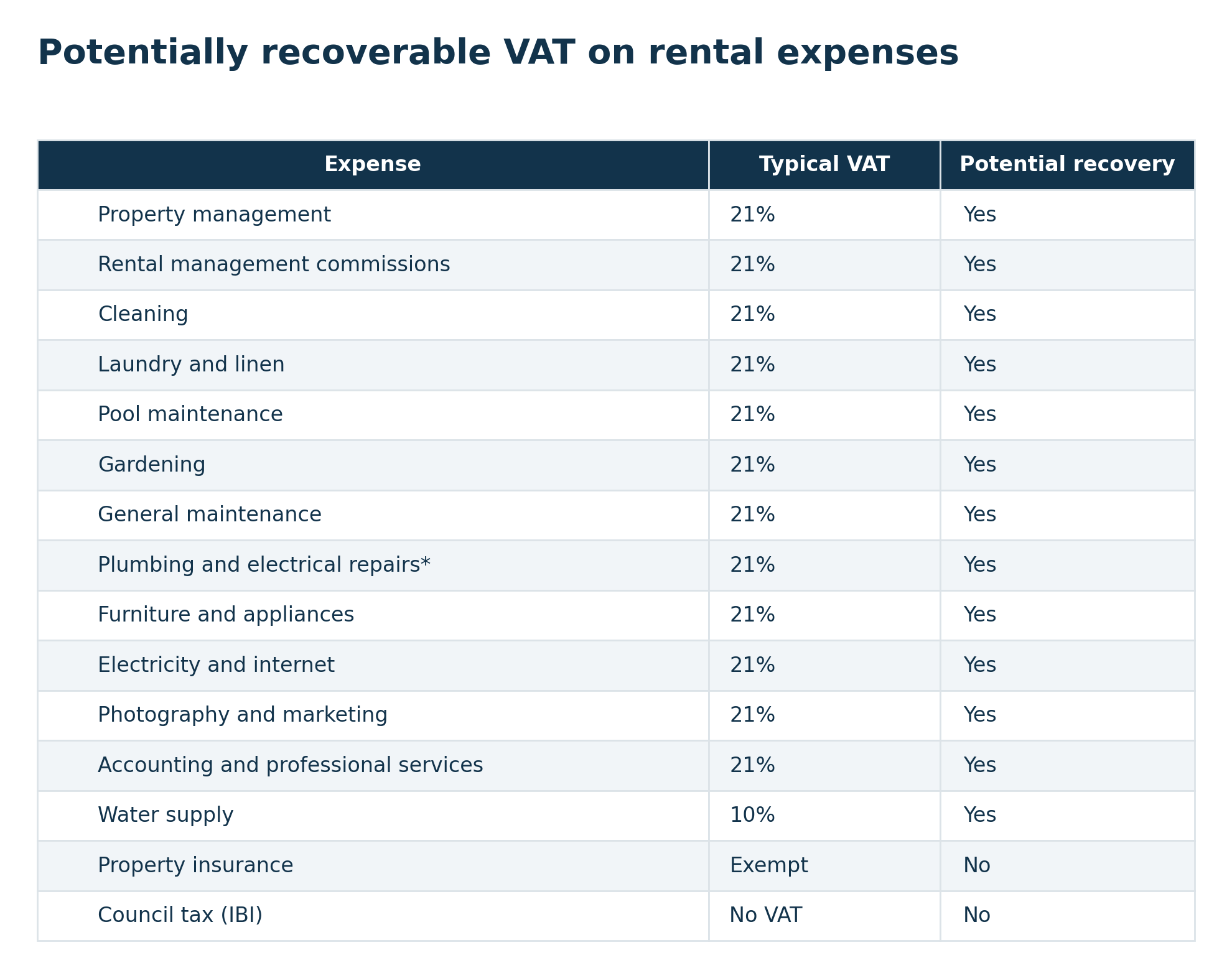
Under the new arrangements, owners may be able to offset eligible VAT paid on property-related expenditure against the VAT collected from guests. This is particularly beneficial because many property management and maintenance services carry Spain's standard VAT rate of 21%, whilst qualifying holiday rental income will be subject to the reduced rate of 10%.
Which property-related expenses could qualify?
VAT rates may vary depending on the nature of the service and applicable conditions.
Recovery is subject to normal Spanish VAT deduction rules, including the requirement for expenditure to relate to taxable rental activity and be supported by valid invoices. Where properties are also used personally or for VAT-exempt rentals, restrictions or proportional deductions may apply.
A practical example of how VAT can be offset
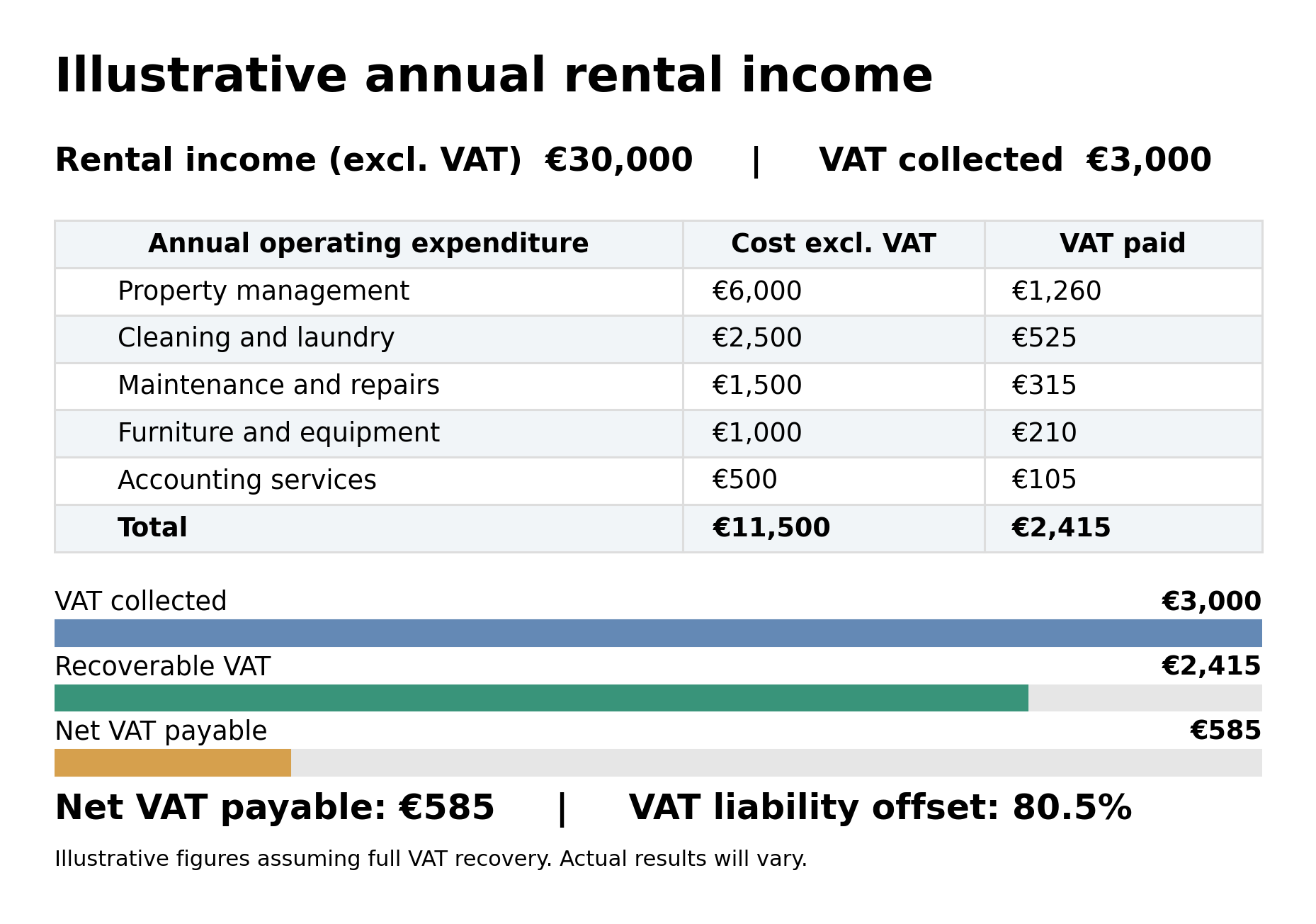
Consider the owner of a two-bedroom holiday apartment on the Costa del Sol generating €30,000 in annual rental income, excluding VAT. The owner uses a professional property management company and incurs various operational expenses throughout the year.
In this example, although the property owner collects €3,000 in VAT from rental guests, the recovery of €2,415 in VAT paid to suppliers reduces the net amount payable to the Spanish tax authorities to just €585. This demonstrates why the introduction of 10% VAT does not necessarily translate into a 10% reduction in rental profitability.
Will holiday rental prices increase by 10%?
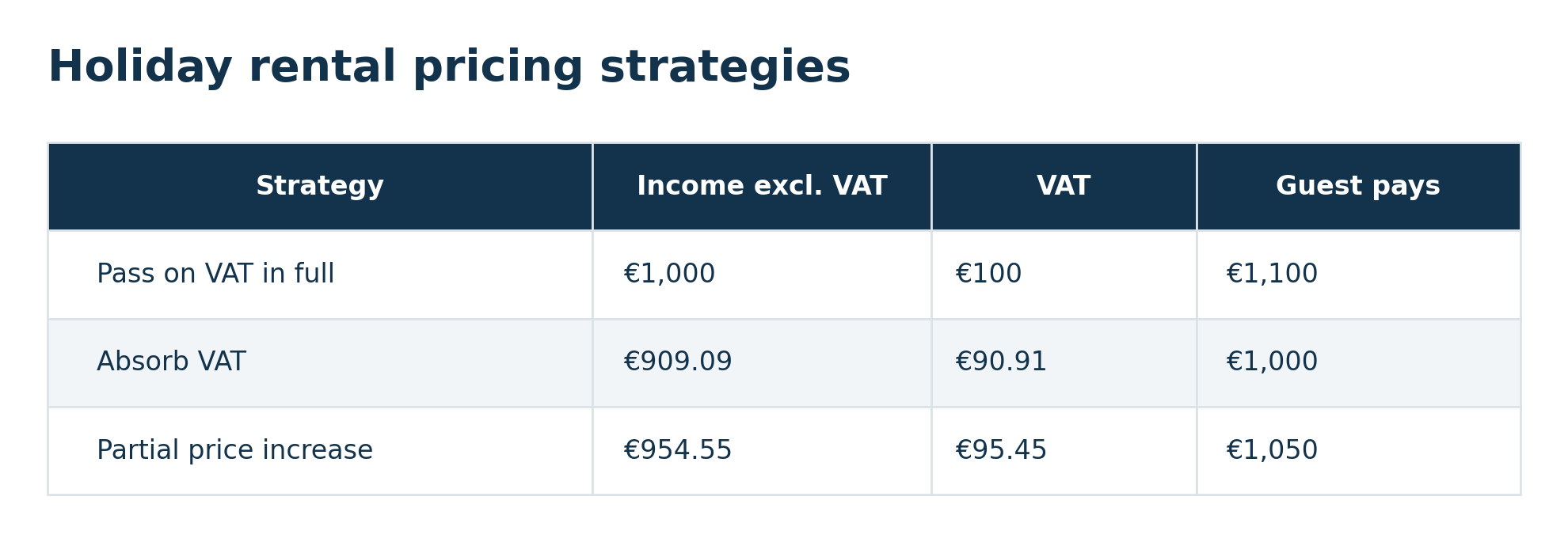
Property owners will need to consider whether to pass the additional VAT on to guests, absorb it within existing rental prices or adopt a combination of both approaches. For example, a property currently advertised at €1,000 per week could be priced in the following ways:
Pricing strategy
The ability to recover VAT on operational expenditure could allow some owners to absorb part of the increase whilst remaining competitive. Across Andalucía, where rental demand varies considerably between peak summer periods and the quieter winter months, flexible pricing strategies will become increasingly important.
The growing importance of professional property management
The new legislation could further encourage the professionalisation of Andalucía's holiday rental sector. For owners already using professional property management companies, the ability to reclaim the 21% VAT charged on management fees could make these services more financially attractive.
A property management service costing €1,500 plus €315 VAT previously represented an effective expense of €1,815 for an owner operating a VAT-exempt rental. Under the new arrangements, an owner entitled to full VAT recovery could reduce the effective cost of the same service to €1,500. Professional property management companies can also play an important role in maintaining accurate booking records, coordinating supplier invoices, monitoring rental income and assisting owners with the administration required to meet their new tax obligations.
What should property owners do before 1 December 2026?
Spanish and overseas property owners should review their rental arrangements and prepare for the new legislation by taking the following steps:
VAT Registration: Review registration with the Spanish tax authorities using Modelo 036.
Review existing bookings: Seek advice regarding advance payments, deposits and reservations spanning the implementation date.
Obtain valid VAT invoices: Ensure suppliers issue invoices in the property owner's correct name, with the relevant tax identification details.
Maintain accurate accounting records: Record rental income, VAT collected and eligible VAT expenditure.
Submit VAT returns: Prepare for periodic VAT declarations, typically through Modelo 303, together with any applicable annual reporting requirements.
Review personal property usage: Establish whether private use or exempt rental activity will restrict VAT deductions.
Consult a Spanish tax adviser: Confirm the appropriate treatment of income, expenditure and existing rental management agreements
Owners should also remember that VAT is separate from Spanish resident or non-resident income tax obligations.
Looking ahead: The future of Andalucía's holiday rental market
Despite the additional administrative responsibilities, the introduction of VAT does not necessarily represent an entirely negative development for Andalucía's holiday rental sector. The region continues to benefit from its international appeal, Mediterranean climate, established tourism infrastructure, international airport connectivity and popularity as a year-round holiday destination.
For owners who maintain high-quality accommodation, adopt effective pricing strategies and maximise legitimate VAT recovery on operational expenses, the financial impact of the new legislation could be considerably less than initially anticipated. The key will be understanding that the new system involves not only collecting VAT on rental income but also recovering VAT on eligible expenditure.
For many property owners across Andalucía, effective financial planning, professional property management and accurate accounting will be increasingly important in protecting rental profitability throughout 2027 and beyond. Official sources and further reading:
Updated guidance published 23 November 2026 Disclaimer: This article is provided for general informational purposes and reflects the legislation as of 24 November 2026. Property owners should obtain independent professional tax advice regarding their individual circumstances.
Our industry stories
Latest market trends, investments, and property developments in the Iberian Peninsula